

Firearms are powerful tools. When handled responsibly they can serve lawful purposes like security or sport shooting; when misused they become causes of tragedy. In the Philippines, where gun ownership exists under regulated law and rich cultural context, safety isn’t just a checklist — it’s a personal and social mindset.
This guide breaks down essential principles, legal context, and habits that every Filipino gun owner or prospective gun owner should know.
1. Understanding the Legal Framework
Before discussing safety habits, it helps to ground yourself in the law:
The Philippines regulates civilian firearms ownership through the Republic Act 10591 (“Comprehensive Firearms and Ammunition Regulation Act”). Key points include:
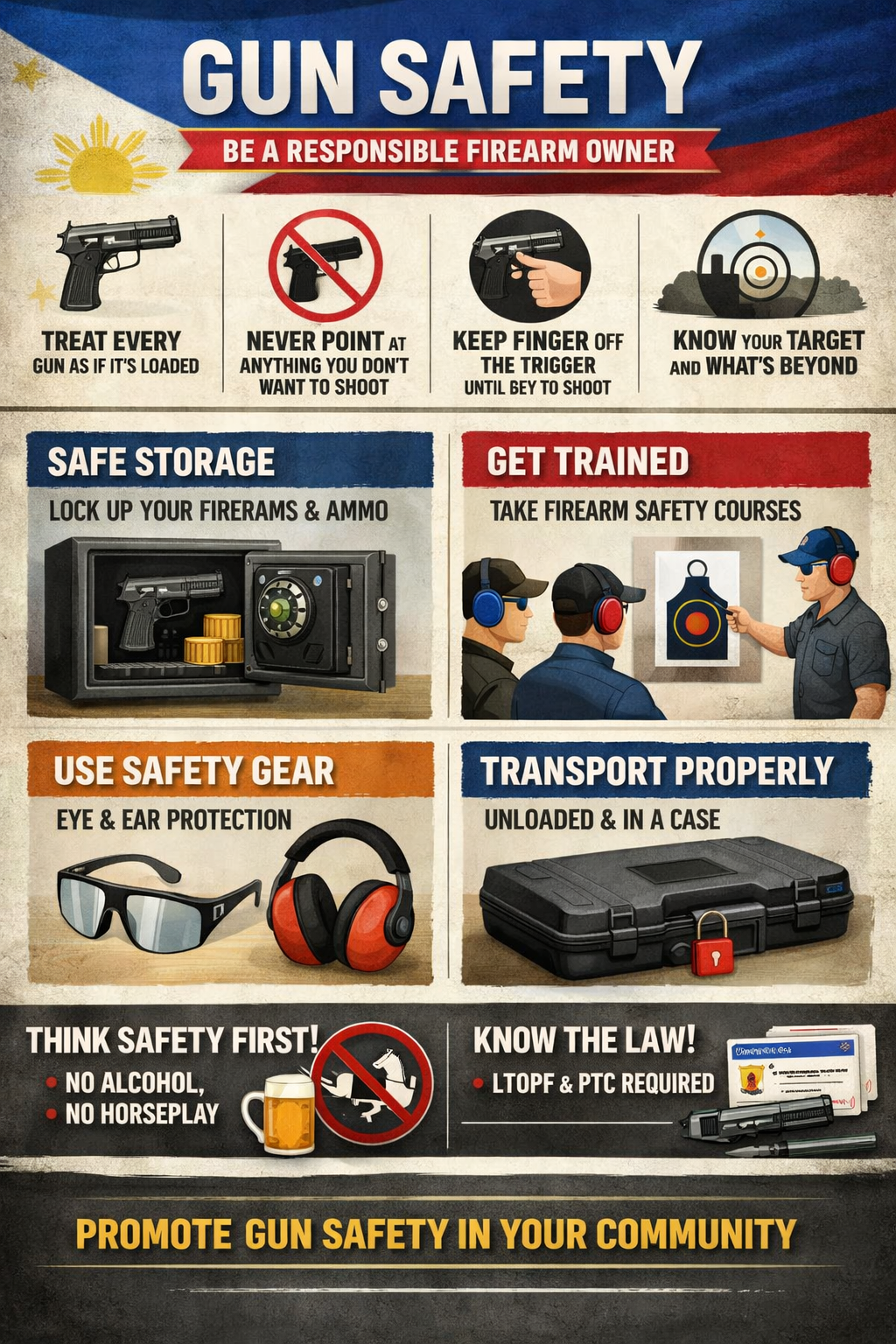
- You must have a License to Own and Possess Firearms (LTOPF).
- Registration of each firearm and ammunition is mandatory.
- Carrying in public requires a separate Permit to Carry (PTC).
- You must be of legal age, pass background checks, drug tests, and mental health screening.
- Violations can lead to fines, imprisonment, and loss of firearm rights.
Understanding the law isn’t optional — it’s foundational to responsible gun culture.
2. The Four Universal Rules of Gun Safety
These rules apply regardless of your experience level, location, or firearm type:
Rule 1: Treat every firearm as if it is loaded.
Even if you think it’s unloaded, assume it is. False assumptions lead to accidents.
Rule 2: Never point your firearm at anything you are not willing to destroy.
Muzzle discipline reduces risk of accidental injury.
Rule 3: Keep your finger off the trigger until your sights are on target and you intend to shoot.
Rest your finger outside the trigger guard until the moment of firing.
Rule 4: Be sure of your target and what’s beyond it.
Bullets travel far — know what the shot could hit if it misses or passes through.
These rules are simple, but they are the bedrock of safe handling.
3. Safe Storage Saves Lives
Most accidental shootings occur at home. Safe storage prevents unauthorized access, especially by children.
Best practices:
- Use a gun safe, lockbox, or heavy cable lock.
- Store ammunition separately from firearms.
- Keep keys or combinations secure and known only to responsible adults.
- Never leave guns unsecured, even “for a moment.”
Safe storage isn’t about inconvenience — it’s risk reduction.
4. Transporting Firearms Properly
In the Philippines, transporting a firearm requires adherence to both legal permits and safety practices:
- Firearms must be unloaded when being transported.
- Store them in a locked case.
- Keep licenses and permits accessible in case authorities ask.
- Never brandish or display a firearm in public unless legally authorized.
Respectful and lawful transport demonstrates responsibility.
5. Training Isn’t Optional — It’s Essential
Handling a firearm safely requires skill, not just theoretical knowledge.
Seek formal training:
- Attend accredited firearm safety courses.
- Learn from certified instructors.
- Practice trigger control, stance, grip, sight alignment, and emergency malfunction procedures.
- Renew and update training regularly.
Training builds confidence and competence — reducing risk for you and others.
6. Mindset Matters: Respect and Responsibility
Guns respond to physics, not intentions. Your mindset shapes how you treat them.
A responsible gun owner:
- Respects life over ego.
- Avoids alcohol or drugs before handling a firearm.
- Recognizes that owning a gun means owning the responsibility for every round fired.
- Communicates safety practices to family and peers.
Safety is a culture, not a checklist.
7. What to Do in Case of an Incident
If an accidental discharge or unsafe event occurs:
- Ensure everyone is safe — call emergency services if needed.
- Secure the firearm — unload and lock it.
- Report it to authorities — cooperating with law enforcement protects you and your community.
- Reflect and retrain — use the event as a learning moment.
Responsibility includes transparency after mistakes.
8. Common Myths vs Reality
Myth: “A gun protects me better than not having one.”
Reality: A gun is only as safe as the person behind it — training and judgment are what protect you.
Myth: “I don’t need safety gear for short sessions.”
Reality: Eye and ear protection prevent long-term injuries every time you shoot.
Dispelling myths prevents complacency.
9. Safety Gear: Don’t Skip It
Whenever firing a gun, use:
- Eye protection — prevents injury from debris and gases.
- Ear protection — saves your hearing from permanent damage.
- Appropriate clothing — non-slip, no loose fabrics near mechanisms.
Safety gear isn’t optional — it’s part of responsible ownership.
10. Building a Safer Community
Responsible owners model good behavior. Talk about safety with:
- Family members
- Friends with guns
- New gun owners
- Local shooting clubs
Promote safety courses, safe storage practices, and lawful behavior.
Community norms shape real change.
Final Thought
Gun safety isn’t just a list of steps. It’s a habit of mind and action grounded in respect for life and law. Whether you own a firearm for sport, protection, or collection, the principles above help keep you, your family, and your community safe. In the Philippines’ evolving landscape, responsible gun culture strengthens society — one safe choice at a time.



 then choose "Install".